
Block Puzzle: How to Avoid a Dead Board and Score Higher
Why block puzzle runs end suddenly, and the placement habits that extend them: edge-first packing, keeping a 3x3 open, and reading all three pieces.
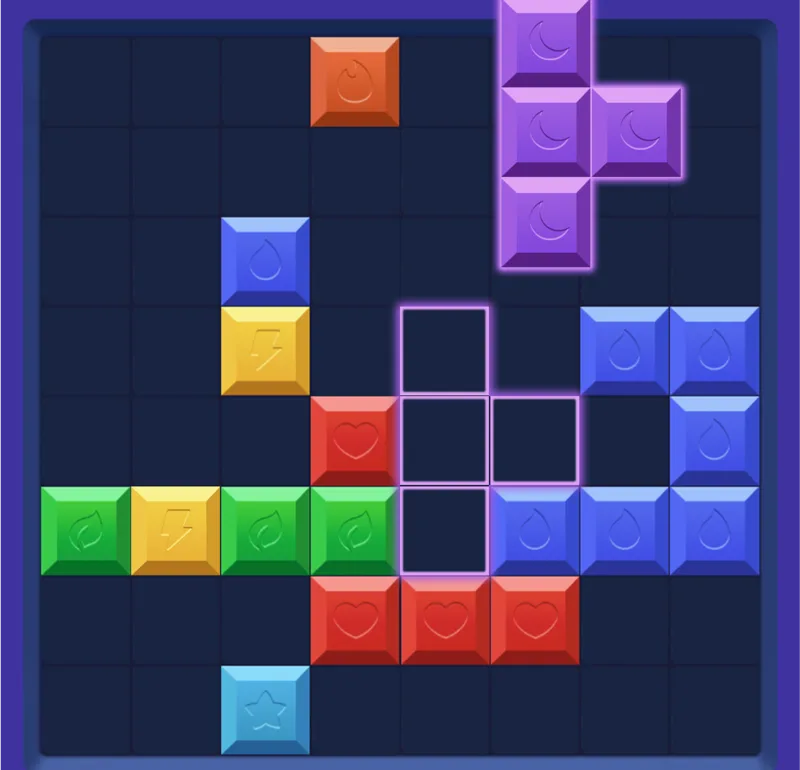
Block puzzle has no timer and no failure state until suddenly it has both. A run ends the moment none of your three offered pieces fits. Everything below is about making that moment arrive later.
Fragmentation is what kills a run
A grid that's 70% full but neatly packed against the edges can accept almost any piece. A grid that's 40% full but scattered with single-cell holes cannot accept a 3x3 square, and the 3x3 square is coming.
So the metric to watch isn't how much space is left. It's how much of your space is contiguous.
Place against what's already there
Every piece you drop should touch an existing block or a wall. Pieces placed in open space create gaps on both sides; pieces placed flush extend a solid region.
In practice this means filling from the edges inward, and preferring the corner that already has material over the one that's clean.
Always read all three pieces before placing the first
This is the single highest-value habit and most players skip it. If you're offered a 1x1, a 1x4 line and a 3x3 square, the square dictates everything. Place it first, or at least place the others so a 3x3 opening survives.
Placing the small piece first because it's easy is how you discover, twenty seconds later, that nothing fits the square.
Protect one large opening
Try to keep a clear 3x3 area somewhere on the board at all times. It costs you a little efficiency and it buys you the ability to survive the worst piece in the deck. When that region gets consumed, rebuilding it should become your priority over clearing lines.
Clear lines, but not at any price
Clearing is the only way to recover space, so it's tempting to take every clear on offer. Take the ones that don't fragment what's left. A clear that removes a row but leaves a checkerboard of holes above it has made your position worse, not better.
Prefer clears that:
- Remove a row or column adjacent to your densest region.
- Leave the remaining blocks flush against an edge.
- Set up a second clear next turn.
The habits, in order of value
- Read all three pieces before placing any.
- Place flush against existing blocks or walls.
- Keep one 3x3 region open.
- Prefer clears that leave the board contiguous.
- Fill from edges toward the centre, not the reverse.
Why scores plateau
Most players plateau because they optimise for the current move, the tidiest-looking placement right now, rather than for the piece they can't predict. Block puzzle is a game about the piece you haven't been dealt yet.
Play a run consciously applying rule 1 alone and watch how much further you get.
Play these games
Brainy Blocks
A challenging and addictive puzzle game that will test your problem-solving skills!