
How to Play Bus Escape: Parking Puzzle
Fixed car paths, colour-matched passengers, bus capacity, and why the queue decides a Bus Escape level rather than the lot.
3 min read
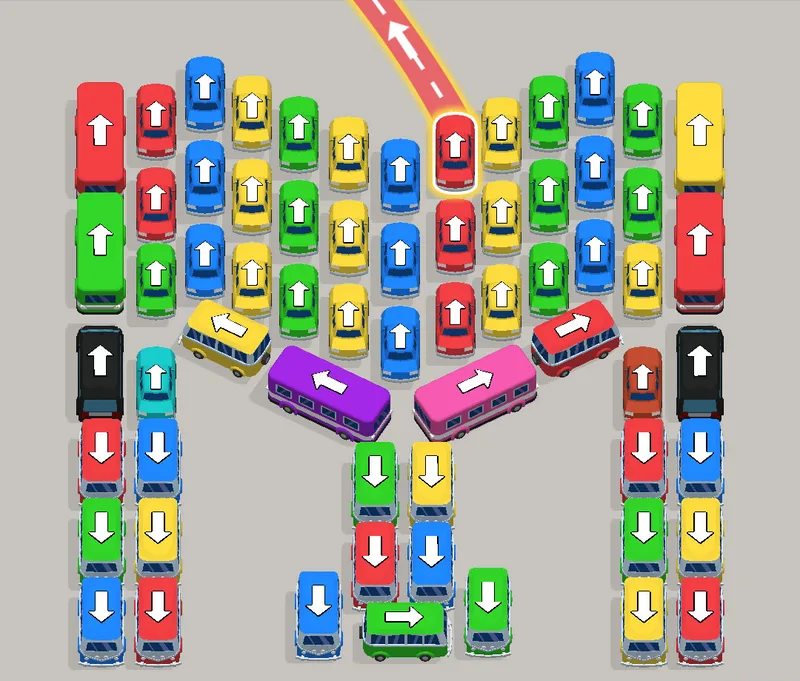
Bus Escape: Parking Puzzle is two puzzles stacked on top of each other. The lot is an unblock puzzle: vehicles are in each other's way and have to leave in the right order. The queue is a sorting puzzle: colour-coded passengers have to board buses that match them. You lose when the second one jams, not usually the first.
The lot: every vehicle has a fixed path
Tap a vehicle and it drives out along its own path: the route it's pointed down, not a route you choose. You don't steer. Your only decision is which vehicle to tap and when.
That makes the lot a dependency problem rather than a driving one. A vehicle whose path is crossed by another vehicle can't leave yet. Clear the one in the way first, and the one behind it becomes tappable. Before your first tap, look down each vehicle's nose and ask what's sitting on that line.
The queue: colours have to match
Passengers wait in a line and each one has a colour. A passenger boards only a bus of the same colour. You can't reorder the queue and you can't skip anyone. The front of the line is the passenger you have to deal with next.
So the question every turn is: is there a bus in place for the colour at the front of the queue? If yes, that passenger boards and the next one steps up. If no, the queue stops moving, and the lot stops mattering.
Capacity: buses hold 4, 6 or 8
Buses come in three sizes. This is easy to skim past and it's the number that decides tight levels.
An eight-seat bus that pulls away with two passengers aboard has thrown away six seats, and those seats were the level's supply of somewhere for that colour to go. Count the queue before committing a bus: if there are five red passengers waiting and you have a four-seater and a six-seater in red, the six-seater is the one that finishes the job.
Putting it together: one turn at a time
- Look at the front of the queue. Note the colour, and how many more of that colour are behind them.
- Find a matching bus. Is one already in position, or does one need to come out of the lot?
- If it needs to come out, trace its path. Whatever sits on that line is what you tap first.
- Check the seats. Will this bus absorb the whole run of that colour, or will it leave passengers stranded with no matching bus left?
- Then tap.
The order matters because moves are one-way. A vehicle you send out of the lot is gone; there's no putting it back to make room.
Boosters
Boosters exist to break a jam: pulling a vehicle out of turn, clearing a blocked path, buying a way out of a lot that's gridlocked. They work, and they're finite.
Spend them on a board you've misplayed, not on one that's merely slow. A level where the queue is still moving isn't stuck; it's just tight. Save the booster for the board where the front of the queue has no matching bus reachable at all, because that's the state you can't play your way out of.
What the game doesn't tell you
Space in the lot is worth more than progress. Sending a vehicle out early because you can, rather than because you need to, is usually fine. Sending one out that was the only thing keeping a lane open is not, and you'll only notice two turns later.
The leaderboard rewards efficiency, not speed. There's no timer forcing your hand. Reading the queue takes a few seconds and saves restarts.
It plays offline. The full game, including progression, works with no connection, which is the difference between a flight with something to do and one without.
When it goes wrong
When the lot locks up and the queue stops moving, the recovery options are narrower than they look. See why you get stuck in Bus Escape.