
How to Get Every Block Out the Right Door in Block Slide: Color Master
Colour-door sliding puzzles change the goal: no target block, no filler pieces. How exit order, edge choice and door side decide whether a board clears.
4 min read
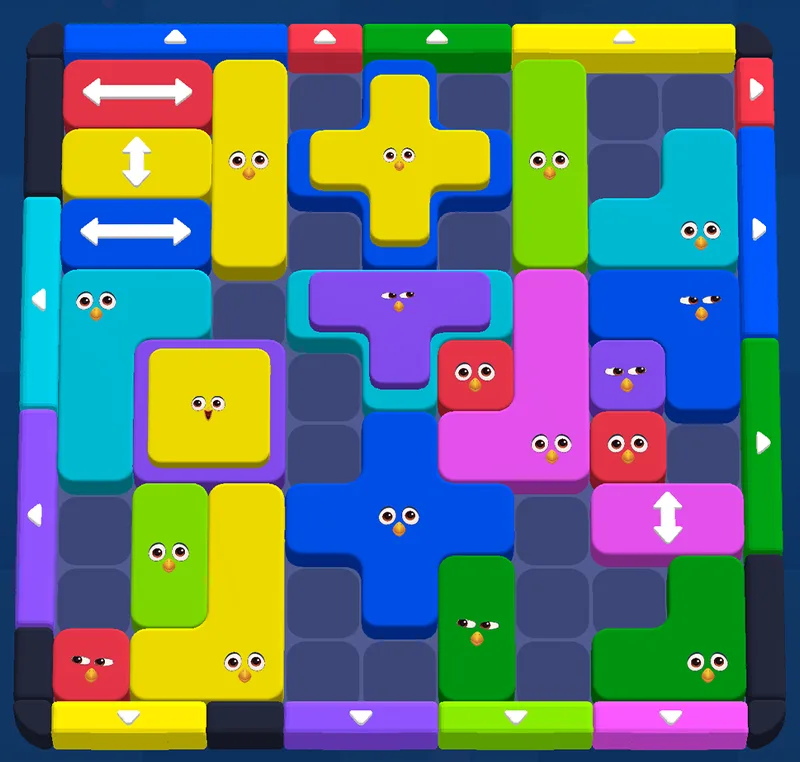
Classic sliding puzzles give you one piece that matters and a board full of obstacles. Block Slide: Color Master removes that distinction: every block has to leave, each through the door matching its colour. Nothing on the board is filler, which changes almost every habit you brought from the classic version.
The three things a block needs
Before a block can leave, all three have to be true at once:
- It's aligned with its door. A horizontal block leaves through a door on the left or right edge, on its row. A vertical block leaves top or bottom, in its column. A red block sitting in a row with no red door is not going anywhere from that row.
- The lane between it and the door is empty.
- You move it in that direction.
Most of the puzzle is (1). Beginners spend their moves on (2), clearing lanes, for blocks that were never in the right row to begin with.
Exit order is the whole game
Every block that leaves is space that stays free for the rest of the level. That makes exits compounding: the first one is hard, the fourth is easy, and a board that felt impossible loosens once three or four pieces are gone.
So take the free ones first. Scan for any block already aligned with its door and with a clear or nearly clear lane, and remove it, even if it wasn't part of your plan, and even if it looked harmlessly out of the way. There is no such thing as a block that's out of the way here; it has to leave eventually.
Check the door side before you park anything
This is the mistake that costs the most moves.
In a classic escape puzzle, the advice is to park blockers on the edge to keep the middle open. That still holds, but the edge you pick matters. A block pushed to the left edge when its door is on the right has to travel the full width of the board later, through whatever has filled in behind it.
Before moving a blocker out of the way, glance at where its door is and push it toward that side. You get the space you needed and a block that's closer to done. When both directions clear the lane equally, door side is the tiebreaker every time.
Blocks that can't reach their door yet
Some blocks start in a row or column with no matching door. Those need a perpendicular move first: slide them along one axis into a lane that does have their door, then out.
But a block only moves along its own length. A horizontal block can never change rows. So a horizontal block in a row without a matching door isn't waiting for space. It's waiting for a door, and if the level has no red door on its row, that block was never leaving that way. Re-read the board: either there's a door you missed on the other end, or you've mistaken which axis the block sits on.
Getting this wrong is the usual reason a level looks broken. It's almost never broken.
Late board, tight board
Once most blocks are out, the remaining ones are usually long pieces that need a full clear run. Two rules for the endgame:
- Move long pieces before short ones. A four-cell block needs four contiguous cells. Short blocks fit in leftovers; long ones don't.
- Don't fill the last open lane. With three blocks left, the empty column running down the middle is the only thing letting anything reposition. Park in it and you've tangled a board that was two moves from solved.
Restarting costs nothing
No timer, no move limit, no randomisation. The level you restart is exactly the level you just failed, and you already know which opening didn't work. If five moves in the board is no closer to clearing, undo back to a state you understood rather than pushing on. Daily challenges aside, nothing here is lost by taking a board twice.
The same slide-and-match logic drives Block Worm: Color Jam, where the pieces are worms that bend rather than rigid blocks; the colour-matching goal is identical, the movement is looser.
For the classic single-target version of the genre, see how to play block escape puzzles and the tips post.