
Escape Puzzles vs. Block Puzzles: Which One Suits You
Both are grids full of blocks and they reward opposite instincts. One is a fixed problem with a solution; the other is an endless run you eventually lose.
4 min read
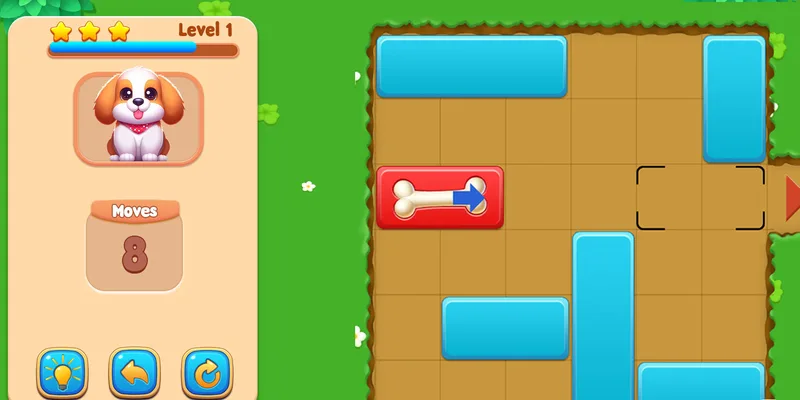
They look like the same game in the store: a grid, coloured blocks, a tidy geometric icon. They are not the same game, and people who bounce off one often assume they'd dislike the other.
Escape puzzles: a fixed problem with a solution
You're given a crowded board where pieces slide along their own axis, and something has to get out: one target block, or in the colour-door variant, all of them.
The board never changes. No new pieces arrive. The arrangement you see on load is the entire problem, and it has at least one solution, which means every failure is a failure of order rather than luck.
You fail by tangling, not by running out. There's no score, no timer, no piece queue. You lose a level by filling the space you needed, and you fix it by undoing.
What it rewards: working backwards. Find the exit, list what's in the way, work out what has to move before that can move. Levels are dependency chains three or four links long, and reading the chain before your first tap is nearly the whole skill.
Try Block Escape: Relax Toy for the classic single-target version, or Block Slide: Color Master for the colour-door variant where every block has to leave.
Block puzzles: an endless run you eventually lose
You're given an empty or partly filled grid and a small set of pieces to place, usually three at a time. Fill a full row or column and it clears. Fill the board and the run ends.
The board is yours to shape, and the pieces aren't. You choose where things go; you don't choose what arrives. That asymmetry is the entire game.
You fail by running out of room. There's no solution to reach, only a run to extend. Every session ends in a loss. The question is how long you lasted and how many points you banked.
What it rewards: keeping options open. Good players don't chase the clear in front of them, they maintain a board that can accept any piece the game offers next, which usually means keeping a large contiguous area open rather than nibbling at edges.
Try Block Puzzle Jewel or Brainy Blocks.
Side by side
| Escape puzzle | Block puzzle | |
|---|---|---|
| Board | Fixed at load | Built by you |
| Input | Slide existing pieces | Place new pieces |
| Goal | Get a piece out | Clear lines, keep going |
| Ends when | You solve it | You run out of room |
| Randomness | None | The piece queue |
| Mistakes are | Undoable | Permanent |
| Session length | One level, then stop | Until you lose |
Which one you'll prefer
Pick escape puzzles if you like a problem that stays still while you think about it. Nothing is hidden, nothing is random, and there's no penalty for staring at a board for two minutes. The satisfaction is the click of seeing the chain, and because levels are discrete, it's easy to play three and put the phone down.
Pick block puzzles if you like pressure and don't mind that every run ends badly. The appeal is a long streak and a score that keeps climbing, and the tension of a piece queue you can't control. Sessions run as long as you're good, which is either the draw or the problem depending on your mood.
A useful tell: how do you feel about undo? Escape players use it constantly and think nothing of it. In a block puzzle there's often nothing to undo: the piece is placed, the board is worse, and you play on from there. If that sounds stressful, start with escape.
The overlap
Both reward the same underlying instinct: protect your empty space, and keep it in one piece. In an escape puzzle, splitting the free area into two gaps means the long block you need to move can't travel. In a block puzzle, the same fragmentation means the next 3x3 piece has nowhere to land. Players who are good at one tend to pick up the other faster than they expect.
If you want the specifics of that second failure mode, it's in how to avoid a dead board in block puzzle. For the escape side, start with how to play block escape puzzles.